Seven Killed, Forty Wounded, Two Accounts: Yemen’s Market Strike and the Verification Gap
On 27 September, a strike hit shops at a market in Yemen’s Ta’iz province. Health authorities in Sanaa counted seven dead and forty wounded. The government in Aden gave a different account.
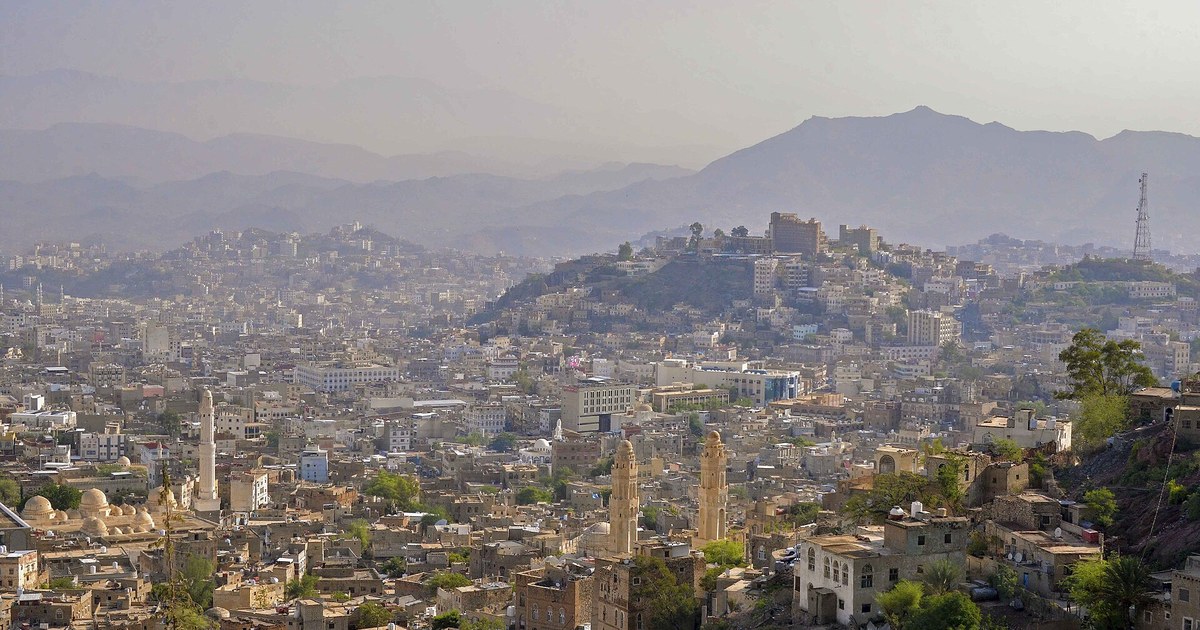
Ta’iz city, seen from the area of Al-Qahirah Castle. The governorate has been the centre of renewed fighting since September 2026. Photo: Rod Waddington / Wikimedia Commons, CC BY-SA 2.0 (2013).
Shortly before midday on 27 September 2026, two strikes hit shops at a market in the Mawiya junction area of Al-Ta’iziyah district, in Yemen’s Ta’iz governorate. The health ministry run by the Houthi movement, which controls the capital Sanaa, said seven people had been killed and 40 wounded, five of them children. A spokesperson for the Houthi-run armed forces said Saudi F-15 aircraft carried out the strike and described it as a crime against civilians.
Yemen’s internationally recognised government gave a different account of the same event. It said its forces had targeted a Houthi military camp and vehicles at the junction, not a market. Three government military sources told Reuters that Houthi fighters had recently established a camp near the market. Neither account has been independently verified, and no independent investigation has published a finding. The intended target, and responsibility for the casualties, remain disputed.
The incident did not occur in isolation. OCHA recorded fighting along the western Ta’iz frontlines from 3 September, and the UN human rights office verified 128 civilian casualties across 37 incidents between 1 August and 22 September: 32 killed and 96 injured, with women and children accounting for more than half. OCHA reported nine health facilities damaged, closed or directly attacked in Ta’iz, Lahj and Al Hodeidah, and the killing of an ambulance driver and an emergency medical responder in Lahj. Hospitals treating the wounded reported shortages of blood, anaesthesia and surgical supplies.
The escalation follows the collapse of a UN-brokered truce that took effect on 2 April 2022 and had largely held for four years. It ended on 13 July 2026, when strikes hit the runway of Sanaa International Airport as an Iranian aircraft carrying a Houthi delegation approached. ACLED recorded them as the first strikes on the airport since 27 February 2022. On 9 October, the UN Special Envoy for Yemen, Hans Grundberg, told the Security Council that the country had slid back into full-scale war, with hostilities spreading across multiple frontlines.
The humanitarian consequences are measurable. The International Organization for Migration recorded more than 200,000 people displaced since early August, with close to 4,000 crossing the Bab el-Mandeb strait towards Djibouti and Somalia. Yemen’s 2026 Humanitarian Needs and Response Plan, launched on 18 March, seeks US$2.16 billion to reach 12 million people out of the 22.3 million assessed as needing assistance. According to OCHA’s Financial Tracking Service, it stood at roughly 20 per cent funded in October.
The longer record is starker. A UNDP assessment published in November 2021 projected that the conflict would have caused 377,000 deaths by the end of that year, nearly 60 per cent of them indirect, through the loss of food, water and health care, and 70 per cent of the total among children under five. Grundberg’s closing argument to the Security Council was procedural rather than sentimental: gains on the battlefield, he said, cannot substitute for the negotiations that will be required to settle the conflict.
Indonesian Summary
Pada 27 September 2026, dua serangan menghantam pertokoan di pasar persimpangan Mawiya, Distrik Al-Ta’iziyah, Provinsi Ta’iz, Yaman. Kementerian kesehatan yang dikelola gerakan Houthi menyebut tujuh orang tewas dan 40 luka, lima di antaranya anak-anak. Pemerintah Yaman yang diakui internasional menyatakan sasaran serangan adalah kamp militer Houthi dan kendaraan di persimpangan yang sama, bukan pasar. Tidak ada pihak independen yang memverifikasi kedua versi tersebut. Serangan ini terjadi di tengah eskalasi setelah runtuhnya gencatan senjata PBB pada 13 Juli 2026. Kantor HAM PBB memverifikasi 128 korban sipil dalam 37 insiden pada 1 Agustus hingga 22 September. IOM mencatat lebih dari 200.000 orang mengungsi sejak awal Agustus. Rencana Kebutuhan dan Respons Kemanusiaan Yaman 2026 membutuhkan US$2,16 miliar untuk 12 juta orang, dengan pendanaan baru sekitar 20 persen pada Oktober.
Al Jazeera, “Deadly strike hits market in Yemen’s Taiz”, 27 September 2026: aljazeera.com
Deutsche Welle, “Yemen: Houthis report deadly Saudi strikes on Taiz market”, 27 September 2026: dw.com
OCHA, Yemen Humanitarian Needs and Response Plan 2026, 18 March 2026: unocha.org
UN Special Envoy for Yemen, remarks to the Security Council, 9 October 2026: dppa.un.org
UNDP, “Assessing the Impact of War in Yemen: Pathways for Recovery”, November 2021: undp.org
ICRC, Protocol Additional I to the Geneva Conventions (1977), Article 57, precautions in attack: ihl-databases.icrc.org
The mechanism on display at the Mawiya junction is not specific to Yemen. Where the toll is compiled by the party that was struck and the target is described by the party that struck it, and where no independent monitor can reach the site, the dead change category by assertion rather than by evidence. In this case the same shops were a civilian market in one account and a military camp with vehicles in the other. Once the location is reclassified, the people inside it are reclassified with it, from shopkeepers and shoppers to persons who were, by proximity, part of a military objective. The burden then shifts to the survivors, who must establish that they were not combatants before their loss is treated as a loss.
Verification is therefore not an administrative step that agencies perform after the fact. It is the step that keeps a death countable and a family eligible for remedy. OCHA has reported movement restrictions and suspended operations along Yemen’s west coast, telecommunications outages delaying verification work in Ta’iz, and the loss of displacement-monitoring access to Al Hodeidah since 9 September. International humanitarian law requires parties to take constant care to spare civilians and to do everything feasible to confirm that a target is a military objective. Where outside monitors cannot perform that check, the practical effect is narrower than justice denied: no verified casualty record means no investigation, no attribution and no route to remedy, whichever account of that afternoon proves correct. The operational lesson is that protection of civilians depends as much on who can still reach the site afterwards as on who was warned beforehand.