Seven Per Cent: How Climate Change Is Redrawing Indonesia's Disease Map
Warming temperatures are opening new territory to disease-carrying mosquitoes and shifting outbreak seasons away from historic patterns, as Indonesia records nearly 60,000 dengue cases in the first half of 2026 alone.
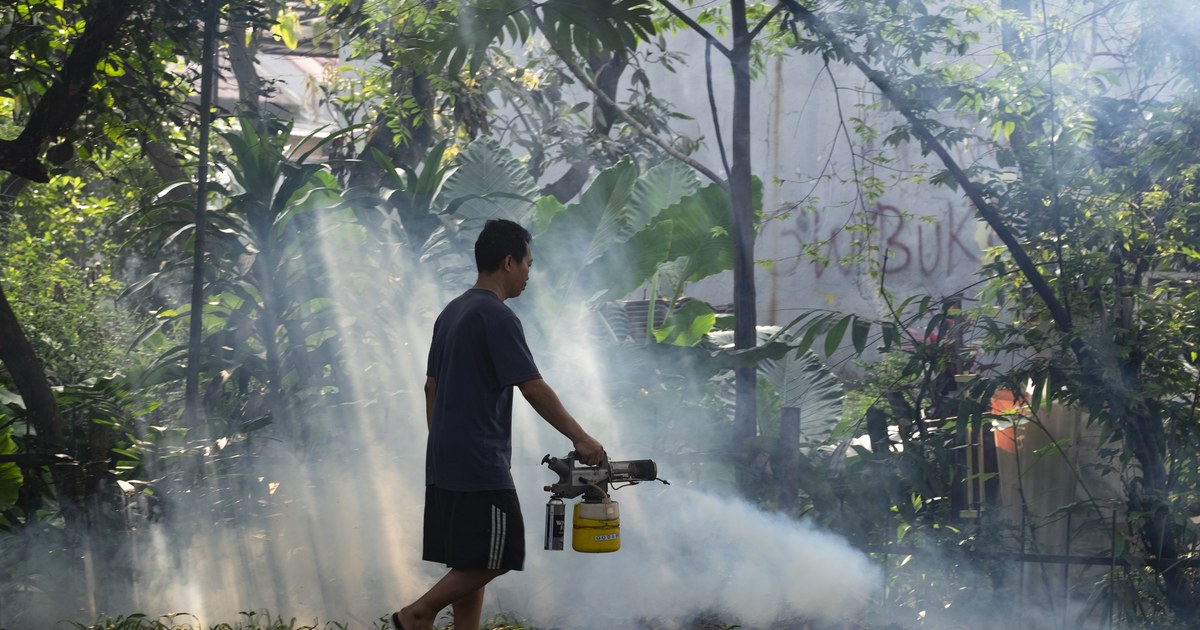
Fumigation to control dengue-carrying mosquitoes in Indonesia. Photo: RaiyaniM, CC BY-SA 4.0, via Wikimedia Commons.
Disease that moves with the weather is not a future scenario. It is a current clinical and public-health reality, according to global and Indonesian data on climate-sensitive infections released through 2026.
The World Health Organization estimates climate change will cause roughly 250,000 additional deaths per year between 2030 and 2050, from malnutrition, malaria, diarrhoeal disease and heat stress. Heat-related deaths among people over 65 have risen 70 percent over two decades. The UN's Intergovernmental Panel on Climate Change, in its Sixth Assessment Report, found that 3.3 to 3.6 billion people live in contexts highly vulnerable to climate change.
Three mechanisms drive the shift in disease patterns. Warmer temperatures accelerate virus replication inside mosquitoes and speed up their biting and maturation cycles; warmer nights extend the vectors' active season and can let them survive winters they previously could not. Erratic rainfall creates breeding sites outside normal seasons while damaging sanitation infrastructure, and floodwater spreads pathogens through the fecal-oral route and drives urban leptospirosis outbreaks. Human responses to floods and droughts, including displacement and disrupted sanitation, open further pathways for exposure.
Indonesia's own data reflects the trend. The health ministry recorded 131,393 dengue cases and 544 deaths between January and 30 October 2025, making the country responsible for about 7 percent of dengue cases worldwide that year. National health insurer BPJS Kesehatan spent roughly Rp1.3 trillion on dengue treatment between January and August 2025, after spending about Rp2.9 trillion across all of 2024.
There is a positive signal alongside the case counts: Indonesia's dengue case fatality rate fell to a record low of 0.4 percent in 2025, down from 0.9 percent in 2021, moving below the national target of 0.5 percent. But the pressure has not eased. WHO reported 58,357 Indonesian cases between January and June 2026, while global dengue cases exceeded 1.5 million between January and 31 July 2026, according to the European Centre for Disease Prevention and Control.
The more consequential shift may be geographic rather than numeric. Regions once too cool for dengue-carrying Aedes mosquitoes are entering risk zones, and outbreak peaks no longer track reliably with the rainy season that historically defined them. A parallel pattern is emerging with malaria: Anopheles mosquitoes are highly sensitive to cold, so warming is opening highland areas that previously offered natural protection. Research in the Ethiopian highlands found that ten-day minimum temperatures at many sites now exceed the threshold that once blocked malaria transmission, exposing populations with no prior immunity to a disease their elevation used to keep out.
Public-health responses under discussion center on surveillance and workforce readiness rather than new technology alone. Environmental history, such as recent flood exposure, is increasingly treated as relevant when diagnosing acute febrile illness. At the system level, Indonesia's national health data platform SATUSEHAT, a One Health approach linking human, animal and environmental health data, and climate-health content in medical education curricula are among the tools being positioned to track a disease map that keeps moving.
Indonesian Summary
Perubahan iklim mempercepat pergeseran pola penyakit menular. WHO memperkirakan sekitar 250.000 kematian tambahan per tahun (2030-2050) akibat perubahan iklim; IPCC AR6 mencatat 3,3-3,6 miliar orang hidup di wilayah sangat rentan. Indonesia mencatat 131.393 kasus dengue dengan 544 kematian sepanjang Januari-Oktober 2025 (sekitar 7 persen kasus dengue dunia), dengan pembiayaan BPJS Kesehatan Rp1,3 triliun. Angka kematian dengue turun ke rekor terendah 0,4 persen pada 2025, namun kasus tetap tinggi: 58.357 kasus pada Januari-Juni 2026. Pergeseran wilayah menjadi sorotan utama: daerah yang dulu terlalu dingin bagi nyamuk kini masuk zona risiko, termasuk pada malaria di dataran tinggi. Kesiapan sistem kesehatan disorot lewat SATUSEHAT, pendekatan One Health, dan kurikulum kesehatan iklim.
WHO, Climate change and health: Fact sheet
IPCC AR6 WGII Summary for Policymakers: Report
Kementerian Kesehatan RI: Bangkit dari El Nino
Detik Health, Kemenkes 2025 data: 131,393 dengue cases in 2025
WHO WPRO, Dengue Situation Update #750: PDF report
ECDC, Dengue worldwide overview: Dengue monthly
WHO, Dengue and severe dengue: Fact sheet
NOAA Climate.gov, malaria expansion in Ethiopian highlands: Report
WHO, Malaria: Fact sheet
A falling case fatality rate is genuine progress, and Indonesia's drop to 0.4 percent deserves recognition. But mortality improving while caseloads climb and geography expands is not a solved problem, it is a problem that has changed shape. Disease surveillance built around historic seasons and historic altitudes will miss what comes next. The task ahead is not just treating more patients in more places; it is rebuilding the assumptions that public-health systems use to predict where the next outbreak begins.